Thursday, 15 December 2016

Section 6- Be able to evaluate legal,ethical and regulatory issues associated with media products


  • Make a list of 5 films that you consider to have violent conduct
  • Research these films and find out the age certificate 
  • Write a sentence whether you think the age certificate is appropriate
  • Feed back to the class
Green Street Hooligans
  • The age certificate is 18
  • I agree with this as there is lots of fights and swearing and blood and someone dies by getting beaten to death
Deadpool 
  • The age certificate is 15
  • I agree with this as the only scene that may be when someone gets there arm chopped off
Django Unchanged
  • The age certificate is 18
  • I agree as it contains strong bloody violence and someone gets killed with a hammer
Moral panic is when the media creates fear in the population over issue that appears to threaten or harm normal social order

Examples of moral panic:
The purge influenced killer clowns here is an article from the daily mirror:

Dr Lynes said phobia of clowns, serial killers, social media, films like the Purge and forthcoming Halloween were behind the terrifying craze sweeping the nation.

He added: "It is important to consider the significance of Coulrophobia, which is a fear of clowns. Clowns possess both human and inhuman qualities which can result in disturbing some individuals.

"This phobia is arguably perpetuated by the contemporary “evil clown” archetype developed in the 1980s, notably popularized by Stephen King’s It, and perhaps influenced by John Wayne Gacy , a real-life serial killer dubbed the Killer Clown in 1978.

Noah Crooks: Boy, 13, 'killed mum after attempting to rape her in row over Call of Duty'

Friday, 2 December 2016

Imaginary Entity

For my imaginary entity I was going to do a football magazine, however I lost my work and I'm going to write about it on here.
These were the pictures I was going to put on the magazine:


Imaginary entity:
Alex is a teenager from Newcastle he enjoys watching football and reading football magazines, he watches football weekly and plays every Sunday. He will be a member of the magazines target audience. Alex also collects football collection stickers, so we have decided to put 2 packets of stickers inside however we will have raise the price as this cost extra.

Section 5- Be able to evaluate research data used by media institutions

Evaluate research data used by media institutions 


Primary- Research that you get on your own, for example personal interviews and surveys. Pros of getting primary research is that you are getting results for yourself and they will be more accurate, a con of primary research is that if you are doing a personal interview there maybe leading questions or biased answers.

Secondary- Research you get from other people, for example the internet. A pro of using secondary research is that it is very quick to get and is a lot less time consuming. A con of secondary research is that results could be from an unreliable source.

Quantitative-  Data that is information about quantities; that is, information that can be measured and written down with numbers. Some examples of quantitative data are your height, your shoe size, and the length of your fingernails. A pro of quantitative data is that you can make graphs out of your results so you get a clear reading of results, a con is that the data won't give any detail of peoples opinions

Qualitative- Qualitative data is typically descriptive data and as such is harder to analyse than quantitative dataQualitative research is useful for studies at the individual level, and to find out, in depth, the ways in which people think or feel (e.g. case studies). Pros of qualitative data is that you get peoples detailed opinions, a con is that you don't get numerical data.

Circulation- The number of people who purchase a print product


Thursday, 24 November 2016

Unit 1- Section 4: Understand the target audiences of media products

Key Terms Summary-

Mainstream Audience- An audience that consumes a product that appeals to a wide range of age groups

Niche Audience- The audience of a specialist interest media product that may only appeal to a small number of people or those that fall within a specific demographic profile (e.g. ethnicity or age)

Demographics- When media producers study the breakdown of their target audiences based on variables in age, ethnicity, gender, economic status or class, level of education, hobbies and interests and lifestyle choices

Psychographics- Profiling of audience members based on their personal beliefs values, interests and lifestyle

NRS social grades- A method of classifying demographics based on occupation and income, developed by the National Readership Survey

RAJAR- The acronym for Radio Joint Audience Research, which collates listening figures for over 300 Radio station across the UK

BARB- The acronym for Broadcasters Audience Research Board which collates viewing figures for all the major UK broadcasters such as BBC, ITV and Sky

Imaginary Entity- A term that suggests media producers have a specific audience member in mind before they plan a media product

Audience Profile- The specific demographic variables of an average target audience member for a given media product based on age, gender, income, ethnicity and interests, that makes them desirable to advertisers and commercial companies.

Tuesday, 15 November 2016

Audience Theory


Uses and gratifications- Blumer and Katz, Denis McQuail


Denis McQuail (1972) discussed four theoretical audience pleasures:


What are they?


1. Survilliance- Our need to know what is going on in the world


2. Personal relationships: Our need to interact with other people


3. Personal identity- Our need to define our identity and sense of self


4. Diversion- The need for escape, entertainment and relaxation


Cultivation Theory:

Another theory that treats the audience as passive
It suggests that repeated exposure to the same message- such as an advertisement- will affect attitudes


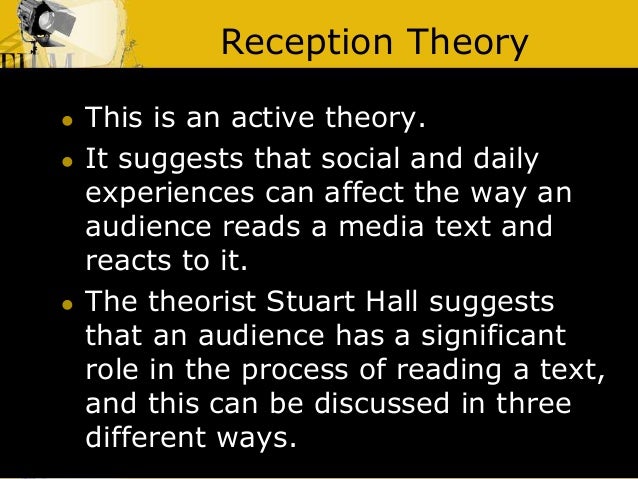
Reception Theory  This is an active theory.  It suggests that social and daily experiences can affect the way an audience reads a media text and reacts to it.  The theorist Stuart Hall suggests that an audience has a significant role in the process of reading a text, and this can be discussed in three different ways.


The Dominant or Preferred Reading  This claims that the audience shares the code of the text and fully accepts its preferred meaning as intended by the producers


Negotiated Reading  This claims the audience partly shares the code of the text and broadly accepts the preferred meaning but can change the meaning in some way according to their own experiences.

Oppositional Reading  This claims the audience understands the preferred meaning but does not share the text’s code and rejects this intended meaning.


Interactive Audiences  These are increasingly popular.  Examples are:  Audiences being asked to be a voter (X Factor etc)  Citizen Journalists – news asking for viewers to send in photos and the like  Documentary style programmes about so called ‘real’ people doing professional things

21st Century Audiences  Websites such as MySpace, YouTube, and blogs offer new possibilities for audiences.  Digital transmission and production means there are many new channels and ways of viewing media texts not just on television but also via the internet.

"Before companies make a product they will have an ideal audience member in mind. This is called an 'imaginary entity'"

What would a company have an ideal audience member in mind before a product is made? So they have an audience in mind and and will target that specific audience

What methods would a company use to research its audience? Primary research e.g. surveys and questionnaires.

Here are 3 examples of imaginary entities, Kiss Radio, their imaginary entity varies at different times depending who's show is on.

Section4: Audience research organisations

Three main ones are BARB, RAJAR and NRS


RAJAR- Radio Joint Audience Research
NRS- National readership survey


The big six

The American film industry is dominated by 6 major film companies.

  • Walt Disney Pictures (Pixar)
  • Universal Pictures (Dreamworks Animation)
  • 20th Century Fox (Sky)
  • Paramount (MTV)
  • Columbia Pictures (Sony)
  • Warner Brothers (DC Films)
I am for the Big Six
  • They produce good films, produce action scenes that British companies couldn't afford
  • A lot of money to add better technical stuff than others
  • Control audiences thoughts

Thursday, 10 November 2016

Additional Theories 3.2

Representation- Laura Mulvey(1975)-Objectification of women in the media
Genre- Rick Altman(1999) Audience pleasures
Narrative- Propp's analysis of folk tales (1920's)

Laura Mulvey believes women are treated as objects and they are denied human identity

Rick Altman , Genre offers audiences a set of pleasures. Altman used semantic, syntactic and pragmatic approach. This aspect includes institution and audiences.

Thursday, 3 November 2016

Unit 1 Section 4- Understanding target audiences of Media Products

4.1 Classifying audiences
Mainstream audiences: An audience that includes a wide range of people.
Niche audiences: The audience of a specialist interest media product that may only appeal to a small number of people or those that fall within a specific demographic profile (e.g. age, ethnicity)

An audience is an individual or collective group of people who read or consume any media text

Why are audiences important?

  • Without audiences there would be no media
  • Media organisations produce media texts to make profit- no audience means no profit
  • The mass media is becoming more competitive than ever to attract more audiences in different ways and stay profitable 
Impact of new technology 

Old media (TV, Print, Radio) which used to have high audience numbers must now work harder to maintain audience numbers.

Digital technology has also led to an increasing uncertainty over how we define an audience, with the general agreement that a large group of people reading the same thing at the same time

Fragmented audience

The division of audiences into smaller groups due to the variety of media outlets.

The aim is to hit as many people as possible/sell more copies/ generate a larger audience. But measuring that audience becomes hard! You may have some people that only look online.

Types of audiences

Mass audience is a different way of saying mainstream audience 

Mass V Niche

Mass: Breaking Bad, Toy Story OK
Niche: MOTD, Football Factory, Match

Demographics- Measurable characteristics of media consumers such as age, gender, complexion, education and income level.
Psychographics- Psychographic segmentation divides the market into groups based on social class, lifestyle and personality characteristics


Wednesday, 2 November 2016

Trailer Analysis HW

I have chosen to choose a clip from The Avengers to analyse. I will be talking about the different camera angles and shots and will also talk about the use of mine-en-scene in the trailer.


These screenshots are extreme close up of two people holding hands before they go in to battle and the other shot shows iron man looking under his costume as he is flying looking rather distressed. The first screenshot of people holding hands as they are about to start fighting, the fact they are holding hands shows that they are in the fight together and there is also complete focus on the hands and and the background is blurred so everybody is focused on the hands. The sound is soft but you get a sense of rising tension as if something is going to happen, foreshadowing potential danger. The Iron man Ext close up makes the audience focus specifically on what Iron man is saying and will intrigue the audience even more by knowing what Iron man sees from looking inside his mask.


These screenshots are mid shots showing a small fight ,Captain America riding a bike and Hulk getting hold of a car and throwing it. For the first screenshot As the fight last 5 seconds and the mid shot enables us to see what they are fighting near and as it is the first actual fight in the scene it sets up the rest of the scene and shows the audience what is to come for the rest of the scene. The angle is slightly moved to the left giving us a different angle to the fight so we can see exactly what moves she uses which attracts the audience. The sound for all screenshots is quite high tempo and fast which you'd associate with an action film and will keep the audience intrigued throughout.


These screenshots are mid shots showing a small fight ,Captain America riding a bike and Hulk picking up a car and throwing it. For the first screenshot As the fight last 5 seconds and the mid shot enables us to see what they are fighting near and as it is the first actual fight in the scene it sets up the rest of the scene and shows the audience what is to come for the rest of the scene. The angle is slightly moved to the left giving us a different angle to the fight so we can see exactly what moves she uses which attracts the audience. The sound for all screenshots is quite high tempo and fast which you'd associate with an action film and will keep the audience intrigued throughout.

Friday, 21 October 2016

TIGA, IDGA homework

Tiga(The Independent Games Developers Association)
  • Non-Profit association representing the UK's games industry
  • There members include independent game developers, in house publisher-owned developers, outsourcing companies, technology businesses and universities.
  • Tiga's vision is to make the UK the best place in the world to do games business, they do this by government lobbying and maintain a voice in the corridors of power at both Westminster and Scottish parliments
  • Tiga is the  network for games developers and digital publishers and the trade association representing the video game industry. There core purpose is to strengthen the game developing and digital publishing sector. They achieve this by campaigning for the industry in the corridors of power, championing the industry in the media and helping their members commercially.
  • TIGA is intent on building an enduring organisation which continually improves; a business that will make a significant impact on the games industry and so benefit our membership and the wider economy. Since 2010, TIGA has won 24 business awards, an achievement which reflects TIGA’s drive for improvement and to meet best practice.
IGDA(International games developers association)
IGDA is the professional association for over 12,000 video and computer game developers worldwide. It is incorporated in the United States as a non-profit organization. Its stated mission is "To advance the careers and enhance the lives of game developers by connecting members with their peers, promoting professional development, and advocating on issues that affect the developer community
  • Independent company
  • Non-profit organization for game software developers
  • Is the largest non-profit membership organization in the world serving all individuals who create games.
  • Their core values are, Community, Professionalism, Innovation, Impact, Leadership and Fun.


Thursday, 20 October 2016

Section 3.2: Narrative

Narrative Theory


Narrative
  1. 1. NARRATIVE A Media Studies Key Aspect
  2. 2. What Is It?  Narrative is the media term for story telling.  Narrative is the way the different elements in a story are organised to make a meaningful story. Some of these elements can be facts as in a documentary, or characters and action as in a drama.
  3. 3. What Is It?  When we look at narrative we see that stories throughout the media share certain characteristics. This often links them to genre.  Different media tell stories in a variety of different ways.
  4. 4. Narrative Structure(s)  This is the way the story or plot unfolds.  Is the story an open or closed structure?  A closed structure means the story ends satisfactorily as in most films – this is known as closure.  An open ending means there is no final conclusion to the story – a television soap has no final ending, it just has minor endings.  Some texts have an interactive structure e.g. Big Brother.
  5. 5. Narrative Structure(s)  A multi-strand structure means there are several narratives running at the same time. This is very common in television, such as Holby City, and The Bill.  Other narrative structures include point of view (POV). (Documentaries often do this)  A popular narrative device is the enigma. The plot constructs a puzzle that the audience is asked to solve while the characters act out the story.
  6. 6. How it is informed  Narrative is informed by character, action, and location.
  7. 7. How it is informed  Characters have functions such as heroes or villains, or someone who assists the hero or villain as a helper or messenger.
  8. 8. How it is informed  The action determines how the events in the narrative occur and the influence they have.
  9. 9. How it is informed  The location of a film or television programme is an important ingredient in how the story unfolds. A horror film about Dracula must have a castle.
  10. 10. How it is informed  Narrative is often delivered to the audience by expectation, suspense, tension and closure.  The audience is led to expect certain things to happen which leads to tension and excitement.  Expectation, suspense and tension are created by the use of Media Language,
  11. 11. Our Job  Directors and producers use many techniques to get a story to an audience in an involving, interesting, exciting and entertaining way. Our job as media students is to find out what these techniques are, and see where and how they are used and what they mean in media texts. This is known as Textual Analysis.
  12. 12. Questions to ask  How is the narrative organised?  What is the audience’s role in relation to the narrative?  How are the characters used in the narrative?
  13. 13. Questions to ask  What techniques of identification and alienation are used in the text?  What else does the filmmaker do to engage our attention and tell the story?  What are the major themes of the narrative and what values and ideology are evident?
  14. 14. Run Lola Run  1998 German thriller.  Dir. Tom Tykwer  Franka Potente (Lola)  Moritz Bleibtreu (Manni)  Dist. Sony Pictures  Budget: $1,750,000  Gross: $7,267,585
  15. 15. Narrative Theory  There are four main theorists to consider:  Tzvetan Todorov  Vladimir Propp  Roland Barthes  Lévi-Strauss
  16. 16. TODOROV  Todorov’s theory has three main parts: 1. The text begins with a sate of equilibrium – everything appears to be normal or calm. 2. There is some kind of disruption or disequalibrium – this is often a threat to the normal situation or it could be just a setback. 3. A new equilibrium is produced to end the narrative. In the best narratives there is some kind of change for the better perhaps in the main character’s behaviour or outlook on life.
  17. 17. TODOROV  Todorov suggests there are five stages to how the narrative progresses: 1. The equilibrium has to be carefully shown (otherwise the disruption may not be dramatic enough to create a strong plot) 2. There is a disruption 3. There is a recognition that a disruption has happened. 4. There is an attempt to repair the damage done by the disruption. 5. A new equilibrium is achieved.
  18. 18. TODOROV  Here narrative is not seen as linear, but as circular.  The narrative is driven by the characters’ attempts to restore the equilibrium, although the end result is not quite the same as the beginning.
  19. 19. PROPP  Propp studied folk tales and he proposed ways of grouping characters and their actions into eight broad character types or ‘spheres of action’.  N.B. One character may occupy more than one sphere of action
  20. 20. Spheres of Action  1. The villain  2. The hero, or character who seeks something, usually motivated by a lack of something (money, love etc.) The hero doesn’t have to be heroic in the way most people would understand it – heroes can be male or female, brave or cowardly.  3. The donor, who provides an object with some magic property.  4. The helper, who aids the hero.
  21. 21. Spheres of Action  5. The princess, reward for the hero, and object of the villain’s schemes. Again, this is not necessarily a beautiful damsel in distress – the princess can be male!  6. Her father, who rewards the hero.  7. The dispatcher, who sends the hero on his way  8. The false hero, the character who also lays claim to the princess but is unsuitable and causes complications.
  22. 22. Star Wars  Match them up
  23. 23. Star Wars - An Example  Villain – Darth Vader  Hero – Luke Skywalker  Donor – Obi-Wan Kenobi  Helper – Han Solo  Princess – Princess Leia  Father – The Rebellion  Dispatcher – R2D2  False Hero – Darth Vader
  24. 24. Levi-Strauss  No, nothing to do with jeans!  He introduced the notion of binary oppositions as a useful way to consider the production of meaning within narratives.  He argued that all construction of meaning was dependent, to some degree, on these oppositions.
  25. 25. Examples  Good vs Evil  Male vs Female  Humanity vs Technology  Nature vs Industrialism  East vs West  Dark vs Light  Dirt vs Cleanliness
  26. 26. Roland Barthes  A name you’ll become very familiar with soon. In the meantime, in terms of narrative he suggested five codes:  The hermeneutic code (the enigma)  The proairetic code (the action)  The semic code (the images)  The symbolic code (the subtext)  The referential code (the cultural influence)

  27. http://www.slideshare.net/andywallis/narrative-5865177

Section 3.2- Genre

Critical and theoretical analysis of media texts

A genre has characteristic features that are known to and recognised by audiences. The same formula is applied time and time again.


Examples of genres for TV shows:

  • Westerns
  • War films
  • Soap operas
  • Crime drama
  • Game shows
  • News
  • Reality


There is also subgenres within genres. Spaghetti westerns, Hammer horror and James Bond films are examples of this.

What makes a genre attractive to audiences? Expectations are fulfilled and they can predict what will happen next.

Why do producers like to work within a genre?  Communication with the audience is instant as key components are easily recognised, this also means there is no need to set up characters and plots as the audience already recognise.

For a genre to become established, certain conventions need to become identifiable in general consciousness of the audience.

Key Components:

  • Stock characters
  • Stock plots, situations, issues and themes
  • Stock locations and backdrops
  • Stock props
  • Recognisable music
  • Generic conventions (What all the above make up)
Disadvantages of Genre:
  • Formulaic media texts
  • Texts that do not fall into line have problems getting shown
  • Texts that are not easily categorised are difficult to sell
Summary:
Genres function according to rules and conventions. They respond to these rules and conventions by developing formulas and patterns. Over time, these formulas and patterns may begin to dominate the way we see.

A brief history of Horror movies: Horror movies began in the 1890's by a film pioneer called Georges Melies. Horror movies were inspired from authors like Edgar Allan Poe, Bram Stoker and Mary Shelley. The horror genre often overlaps with the fantasy, supernatural fiction and thriller genres. Horror movies started as silent short movies, one of the first horror films was Le Manoir du Diable which was made by Georges Melies and is still considered as one of the best horror movies of all time. Though the word "horror" to describe the film genre would not be used until the 1930s, after Universal Pictures released Dracula (1931) and Frankenstein (1931), Hollywood dramas often used horror themes.

Rules to making a horror movie: 
  • Pick a main character
  • Pick a sidekick and make them bicker and compete
  • Pick a universal moment
  • Pick a location
  • Pick a inciting incident
  • Pick a ghost
  • Pick a nightmare
  • Pick a trap
  • Pick the moment the sidekick dies
  • Pick the confrontation


Section 3- Audio

Radio began in the 1920's, the first radio broadcasting was on the 27th of August 1920 in Argentina. Different forms of broadcasting are, Commercial Broadcasting, Non-Commercial Educational and non profit varieties as well as student run campus radios, community radios and hospital radio. FM, DAB and online are all different platforms of radio. Ofcom regulates radio.

https://www.wisebuddah.com/jingles/jingles?genre=13

Friday, 7 October 2016

BBC and Sky Taskl

The PSB company I have chosen is BBC and I have decided to choose Sky to compare it with.

Sky and BBC are both conglomerate companies because they both own smaller businesses inside their own ones, for example Sky own Sky Sports, Sky Movies and Sky Atlantic and BBC have Cbbebies and CBBC

BBC use synergy by using BBC iPlayer online they are merging with the internet. Sky also use synergy they have the sky go app so you can watch sky on your phone while you are out and you can also watch on your laptop


Thursday, 6 October 2016

Magazine front cover conventions- Section 3

Front cover needs to have a purpose as it entices the reader to buy the magazine. Front covers of magazines can make a big impression to customers and they will want to choose the front cover that looks the most appealing. The front cover is made up of a number of different features and conventions. Masthead, this is the name of the magazine, it will always be at the top and will stand out as that's what people see first as it's the biggest font for a word on the page and it will have a stand out colour. The masthead can also give the reader an impression of what the magazine will be like. The tagline is under the masthead this may indicate what the magazine is about and who it is aimed at. The central image, this is crucial to the front cover as this is really what will catch the customers eye before they even look at the printed text. The central image will be relevant to the magazines purpose and audience. The cover model could bring in many customers as famous people will make a magazine more popular. Anchorage this is a term that refers to how images are referred to. In magazines, images will be anchored by captions. Secondary images are any other image used that isn't the central one. Coverlines are located at various points on the front cover, telling readers about the magazines contents and articles they will find. Mode of address refers to the way that magazines communicate with their readers. Puff, this is a device which helps to draw attention and promote certain elements in the magazine. They are often set against colourful backgrounds. Pugs are the "ears"of a magazine and are in the top corner they usually are a promotion for something. Barcode, price and edition will all also be on a front cover of the magazine.

Friday, 23 September 2016

Section 1- Disney V Warp

Compare conglomerate company (Disney) and an independent company (warp)

On October 16th 1923 in Los Angeles Disney was established and Warp films was established 1999 based in Sheffield. Walt Disney was the man who established and owned Disney and Warp films was established by Warp Records founding partners Rob Mitchell and Simon Beckett. It was initially created with financial support NESTA and had a remit to produce a number of short films. Disney own many different companies the obvious one is Pixar, this company creates most of their animated movies, Disney also own Lucas Film, Disney bought this company in 2012 for 4.6 billion of Lucas George. Disney also own ABC and ESPN that are TV programmes in the USA. Warp don't own any other companies as they are a small independent company. Total assets of the Walt Disney Company in the fiscal years 2006 to 2015 (in billion U.S. dollars) This statistic contains data on the total assets of the Walt Disney Company from the fiscal year 2006 to the fiscal year 2015. In 2012, the Walt Disney Company held assets worth a total of 74.9 U.S. dollars.

Thursday, 22 September 2016

Section 3- Mise-en-scene

If a writer uses the word 'rose' the reader is free to imagine any of the millions pf roses there are in the world but if a film shows us a rose, all the viewers will see the same rose.

It refers to all the things that are ' put in scene' as well as the way that we are shown them
Tight Framing: Is usually used for close shots
Loose Framing: Usually in longer shots


Film stills:

  • The close up shot shows his power
  • The lighting used around Daniel Craig is dark and where the light is in the background reflects and shows his facial features
  • The gun isn't focused as they want the audience to concentrate on his face
  • The shot shows the composure on his face which makes him look like an empowering figure
Three-point lighting is a standard method used in visual media such as theatre, videofilmstill photography and computer-generated imagery. By using three separate positions, the photographer can illuminate the shot's subject (such as a person) however desired, while also controlling (or eliminating entirely) the shading and shadows produced by direct lighting.

Fill light a supplementary light used in photography or filming that does not change 

Section 3- Sound

Areas of sound theory

Rhythm: Music, speech and sound effect

Fidelity: The degree of exactness with which something is copied or reproduced.
Parallel Contrapuntal:  When the sound we hear should usually go hand in hand with the image on screen. This is known on Parallel sound. 
Time: Synchronous and Asynchronous sounds
Diegetic and Non-Diegetic Sound: All the sounds u expect to hear/ Things you wouldn't expect to hear
Volume

Section 3- Cinematography Camera Movement

Dolly shot: Tracks are laid on the set to permit a smooth movement of the camera, which can then follow a moving person or object
Tracking shot: A shot taken from a moving vehicle, that follows a moving person and animal
Dollies are used less than they used to be since the invention of steadicam, which gives a smoother and less jerky result than a handheld camera
Reverse tracking: Tracking shots are usually made on a slight angle from the side of the subject; occasionally a following shot will be done from behind
Pan: Following movement on a horizontal axis
Track: The camera moves alongside its subject it's not the same as zooming

Tuesday, 20 September 2016

Section 3- Cinematography Angles and Shots

Cinematography is the art of photography and camerawork in film making.

Different camera shots and angles:
Low angle: Makes the subject look large and powerful. The camera is below eye level
Point of view: Shows what a character would see. Draws the audience into the action
High angle: Makes the subject look small and powerless. The camera is above eye level, also can see what's going on
Medium shot: Shows no more than half the subject. In the case of a person, for example, shot would be from waist up
Extreme close up: Shows a small part of the subject. In the case of a person, for example, the shot would be justas eye or a smile. It provides a lot of detail
Extreme wide shot: Establishes where the scene is set. Provides a lot of information, but not a lot of detail
Over the shoulder: Frames the shot with another person. Makes the audience feel as if they are watching the action
Wide Shot: Shows all or most of the subject, leaving room in the shot for some background to be included. This shot allows actors room to move around the frame without the camera having to follow the action
Close up: Shows the subject filling most of the shot. Provides a lot of detail, for example, an actor's emotions, but does not provide background information.
Crane Shot: A shot taken by a camera on a crane, a device which resembles a huge mechanical arm
Aerial Shot: Shots taken from a plane or Helicopter
Depth of field: Refers to the extent to which the space represented in focus
Focus: Is the quality- the 'sharpness' of an object it is registered in the image
Shallow focus: The camera focuses on objects, in the foreground, so the background is blurry
Rack (or pull) focus: Focus change from one object to another, by lens movement rather than a cut


Juxtaposed shows two shots from two opposites e.g. high angle to low angle

Friday, 16 September 2016

Section 1: Understanding the ownership models of institutions

Conglomerate: A huge company like Disney has smaller subsidiary companies within it. the walt disney company in America's largest media conglomerate in terms of revenue, with Time Warner, Comcast, 21st century fox, CBS corporation and viacom 

Independent: An independent company is a company that stands by its self, for example Warp and Vertical film, 

Cross Media Ownership: Ownership of multi media companies by a person or corporation

Public Service Broadcaster: Broadcasting media for the benefit of the people

Joint Venture: A business arrangement which two or more parties agree to pool their resources together for the purpose of accomplishing a task

Synergy: When two or more entitles work together for a final outcome that is advantage for all.

Thursday, 15 September 2016

Section 3 Understand how meaning is created in Media Products L1

Unit 1 Section 3: Understand how meaning is created in Media Products


M-I-R-A

There are many different ways to approach analysis of a media text. You can use the acronym MIRA to help your basic approach.

M = Media Form: What is this?

The first step in analysis involves naming what you are analysing. Is it a movie poster? The title sequence to a TV drama series? A music video? If it's a newpaper front page, how do you know? Is it advertising or promotion, made by a toy manufacturer or a pop band to promote their product? Is it critical, produced by a magazine, blog or newspaper as commentary on a product? Is it narrative? Does it tell a story in its own right, or does it promote highlights from a longer story (e.g. the trailer for a movie or TV show)? Describe what you are looking at, and say how and why it fits a particular Media Form.

I = Institution: Who Made this?

Your next step is to consider who constructed the text. Was it a big, powerful company with millions of dollars to command, or is it a small, local production, created on a shoestring?

R = Representation: Who or What does this show?

There are people and objects in here - how are they represented in both words and images? Is the representation positive or negative? Is it a stereotype or is it original?

A = Audience: Who is this for?


Every media text is made with someone in mind, whether it's a summer blockbuster movie aimed at all four quadrants, or a niche magazine aimed at Civil War re-enactment enthusiasts. Who do you think the preferred audience is for this text, and how do you think they are expected to interpret it? If it's an ad, will they buy the product? If it's a title sequence, will they keep watching?
http://www.mediaknowall.com/gcse/keyconceptsgcse/keycon.php (Source)
Connotation: The meaning behind something. This can vary between person to person.
Denotation: What something actually is
The areas of textual analysis are sound, camera editing and miss-en-scene.


Unit 1 Media Products and Audiences

Unit 1 Media Products and Audiences

  1. Understand the ownership models of Media institutions 
  2. Understand how media products are advertised and distributed
  3. Understand how meaning is created in media products
  4. Understand the target audiences of media products
  5. Be able to evaluate research data used by media institutions
  6. Be able to evaluate legal,ethical and regulatory issues associated with media products.