Key Terms Summary-
Mainstream Audience- An audience that consumes a product that appeals to a wide range of age groups
Niche Audience- The audience of a specialist interest media product that may only appeal to a small number of people or those that fall within a specific demographic profile (e.g. ethnicity or age)
Demographics- When media producers study the breakdown of their target audiences based on variables in age, ethnicity, gender, economic status or class, level of education, hobbies and interests and lifestyle choices
Psychographics- Profiling of audience members based on their personal beliefs values, interests and lifestyle
NRS social grades- A method of classifying demographics based on occupation and income, developed by the National Readership Survey
RAJAR- The acronym for Radio Joint Audience Research, which collates listening figures for over 300 Radio station across the UK
BARB- The acronym for Broadcasters Audience Research Board which collates viewing figures for all the major UK broadcasters such as BBC, ITV and Sky
Imaginary Entity- A term that suggests media producers have a specific audience member in mind before they plan a media product
Audience Profile- The specific demographic variables of an average target audience member for a given media product based on age, gender, income, ethnicity and interests, that makes them desirable to advertisers and commercial companies.
Thursday, 24 November 2016

Tuesday, 15 November 2016
Audience Theory
Uses and gratifications- Blumer and Katz, Denis McQuail
Denis McQuail (1972) discussed four theoretical audience pleasures:
What are they?
1. Survilliance- Our need to know what is going on in the world
2. Personal relationships: Our need to interact with other people
3. Personal identity- Our need to define our identity and sense of self
4. Diversion- The need for escape, entertainment and relaxation
Cultivation Theory:
Another theory that treats the audience as passive
It suggests that repeated exposure to the same message- such as an advertisement- will affect attitudes
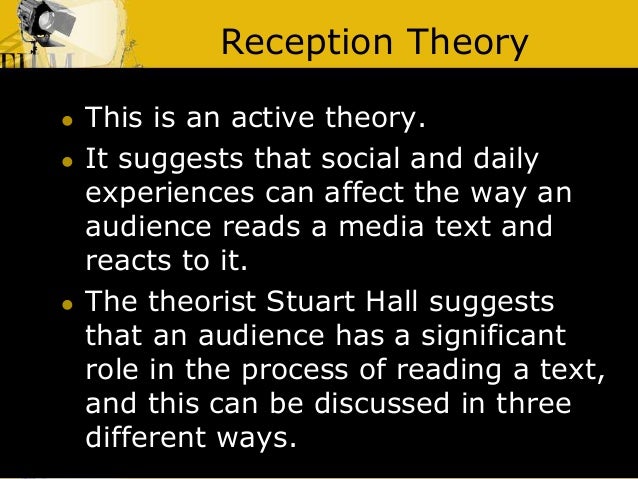
Reception Theory This is an active theory. It suggests that social and daily experiences can affect the way an audience reads a media text and reacts to it. The theorist Stuart Hall suggests that an audience has a significant role in the process of reading a text, and this can be discussed in three different ways.
The Dominant or Preferred Reading This claims that the audience shares the code of the text and fully accepts its preferred meaning as intended by the producers
Negotiated Reading This claims the audience partly shares the code of the text and broadly accepts the preferred meaning but can change the meaning in some way according to their own experiences.
Oppositional Reading This claims the audience understands the preferred meaning but does not share the text’s code and rejects this intended meaning.
Interactive Audiences These are increasingly popular. Examples are: Audiences being asked to be a voter (X Factor etc) Citizen Journalists – news asking for viewers to send in photos and the like Documentary style programmes about so called ‘real’ people doing professional things
21st Century Audiences Websites such as MySpace, YouTube, and blogs offer new possibilities for audiences. Digital transmission and production means there are many new channels and ways of viewing media texts not just on television but also via the internet.
"Before companies make a product they will have an ideal audience member in mind. This is called an 'imaginary entity'"
What would a company have an ideal audience member in mind before a product is made? So they have an audience in mind and and will target that specific audience
What methods would a company use to research its audience? Primary research e.g. surveys and questionnaires.
Here are 3 examples of imaginary entities, Kiss Radio, their imaginary entity varies at different times depending who's show is on.
Section4: Audience research organisations
Three main ones are BARB, RAJAR and NRS


RAJAR- Radio Joint Audience Research
NRS- National readership survey
RAJAR- Radio Joint Audience Research
NRS- National readership survey
The big six
The American film industry is dominated by 6 major film companies.
- Walt Disney Pictures (Pixar)
- Universal Pictures (Dreamworks Animation)
- 20th Century Fox (Sky)
- Paramount (MTV)
- Columbia Pictures (Sony)
- Warner Brothers (DC Films)
- They produce good films, produce action scenes that British companies couldn't afford
- A lot of money to add better technical stuff than others
- Control audiences thoughts
Thursday, 10 November 2016
Additional Theories 3.2
Representation- Laura Mulvey(1975)-Objectification of women in the media
Genre- Rick Altman(1999) Audience pleasures
Narrative- Propp's analysis of folk tales (1920's)
Laura Mulvey believes women are treated as objects and they are denied human identity
Rick Altman , Genre offers audiences a set of pleasures. Altman used semantic, syntactic and pragmatic approach. This aspect includes institution and audiences.
Thursday, 3 November 2016
Unit 1 Section 4- Understanding target audiences of Media Products
4.1 Classifying audiences
Mainstream audiences: An audience that includes a wide range of people.
Niche audiences: The audience of a specialist interest media product that may only appeal to a small number of people or those that fall within a specific demographic profile (e.g. age, ethnicity)
An audience is an individual or collective group of people who read or consume any media text
Why are audiences important?
Mainstream audiences: An audience that includes a wide range of people.
Niche audiences: The audience of a specialist interest media product that may only appeal to a small number of people or those that fall within a specific demographic profile (e.g. age, ethnicity)
An audience is an individual or collective group of people who read or consume any media text
Why are audiences important?
- Without audiences there would be no media
- Media organisations produce media texts to make profit- no audience means no profit
- The mass media is becoming more competitive than ever to attract more audiences in different ways and stay profitable
Impact of new technology
Old media (TV, Print, Radio) which used to have high audience numbers must now work harder to maintain audience numbers.
Digital technology has also led to an increasing uncertainty over how we define an audience, with the general agreement that a large group of people reading the same thing at the same time
Fragmented audience
The division of audiences into smaller groups due to the variety of media outlets.
The aim is to hit as many people as possible/sell more copies/ generate a larger audience. But measuring that audience becomes hard! You may have some people that only look online.
Types of audiences
Mass audience is a different way of saying mainstream audience
Mass V Niche
Mass: Breaking Bad, Toy Story OK
Niche: MOTD, Football Factory, Match
Demographics- Measurable characteristics of media consumers such as age, gender, complexion, education and income level.
Psychographics- Psychographic segmentation divides the market into groups based on social class, lifestyle and personality characteristics


Niche: MOTD, Football Factory, Match
Demographics- Measurable characteristics of media consumers such as age, gender, complexion, education and income level.
Psychographics- Psychographic segmentation divides the market into groups based on social class, lifestyle and personality characteristics

Wednesday, 2 November 2016
Trailer Analysis HW
I have chosen to choose a clip from The Avengers to analyse. I will be talking about the different camera angles and shots and will also talk about the use of mine-en-scene in the trailer.


These screenshots are extreme close up of two people holding hands before they go in to battle and the other shot shows iron man looking under his costume as he is flying looking rather distressed. The first screenshot of people holding hands as they are about to start fighting, the fact they are holding hands shows that they are in the fight together and there is also complete focus on the hands and and the background is blurred so everybody is focused on the hands. The sound is soft but you get a sense of rising tension as if something is going to happen, foreshadowing potential danger. The Iron man Ext close up makes the audience focus specifically on what Iron man is saying and will intrigue the audience even more by knowing what Iron man sees from looking inside his mask.

These screenshots are mid shots showing a small fight ,Captain America riding a bike and Hulk getting hold of a car and throwing it. For the first screenshot As the fight last 5 seconds and the mid shot enables us to see what they are fighting near and as it is the first actual fight in the scene it sets up the rest of the scene and shows the audience what is to come for the rest of the scene. The angle is slightly moved to the left giving us a different angle to the fight so we can see exactly what moves she uses which attracts the audience. The sound for all screenshots is quite high tempo and fast which you'd associate with an action film and will keep the audience intrigued throughout.

These screenshots are extreme close up of two people holding hands before they go in to battle and the other shot shows iron man looking under his costume as he is flying looking rather distressed. The first screenshot of people holding hands as they are about to start fighting, the fact they are holding hands shows that they are in the fight together and there is also complete focus on the hands and and the background is blurred so everybody is focused on the hands. The sound is soft but you get a sense of rising tension as if something is going to happen, foreshadowing potential danger. The Iron man Ext close up makes the audience focus specifically on what Iron man is saying and will intrigue the audience even more by knowing what Iron man sees from looking inside his mask.
These screenshots are mid shots showing a small fight ,Captain America riding a bike and Hulk getting hold of a car and throwing it. For the first screenshot As the fight last 5 seconds and the mid shot enables us to see what they are fighting near and as it is the first actual fight in the scene it sets up the rest of the scene and shows the audience what is to come for the rest of the scene. The angle is slightly moved to the left giving us a different angle to the fight so we can see exactly what moves she uses which attracts the audience. The sound for all screenshots is quite high tempo and fast which you'd associate with an action film and will keep the audience intrigued throughout.
These screenshots are mid shots showing a small fight ,Captain America riding a bike and Hulk picking up a car and throwing it. For the first screenshot As the fight last 5 seconds and the mid shot enables us to see what they are fighting near and as it is the first actual fight in the scene it sets up the rest of the scene and shows the audience what is to come for the rest of the scene. The angle is slightly moved to the left giving us a different angle to the fight so we can see exactly what moves she uses which attracts the audience. The sound for all screenshots is quite high tempo and fast which you'd associate with an action film and will keep the audience intrigued throughout.
Subscribe to:
Comments (Atom)